
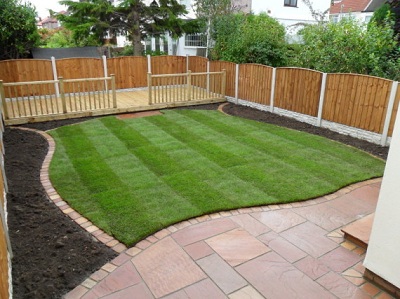
Most of the gardens we are asked to design are for people who are short of time. Mowing a lawn or watering a few pots is a pleasure. A border that has to be dug over every month is not, once work and school runs take the hours.
Low maintenance does not mean a yard of concrete. It means the hard surfaces, the grass and the plants each have a job, and a short regular routine keeps the garden in check.
Hard surfaces on the routes you already use
Patios, paths, gravel, slate and decking belong where you walk: out from the doors, down to the bins, across to a sitting spot. Turf stays where children need somewhere to play. Beds are kept to an edge you can weed in an evening, not a field.
Courtyard gardens are the small version of the same idea. The Humpage courtyard in St Albans is paving, blocks, pebbles and slate, with raised beds, pots and an arch. There is variety, and very little open soil.
Formal or informal, the routine stays small
A formal layout and an informal one can both be easy to live with. The difference is the lines, not the hours. Mrs Marshall’s front garden in Stevenage is the formal end: slab paths, brick edging, a pebble border, a circular lawn and pots by the door. Mrs Antony’s garden in Hertford is the family end: paving and gravel on a few levels, a neat lawn, and a working area at the bottom.
If you enjoy one job — mowing, or looking after pots — say so at the start. The design can leave that in, and take out the work you will not do.